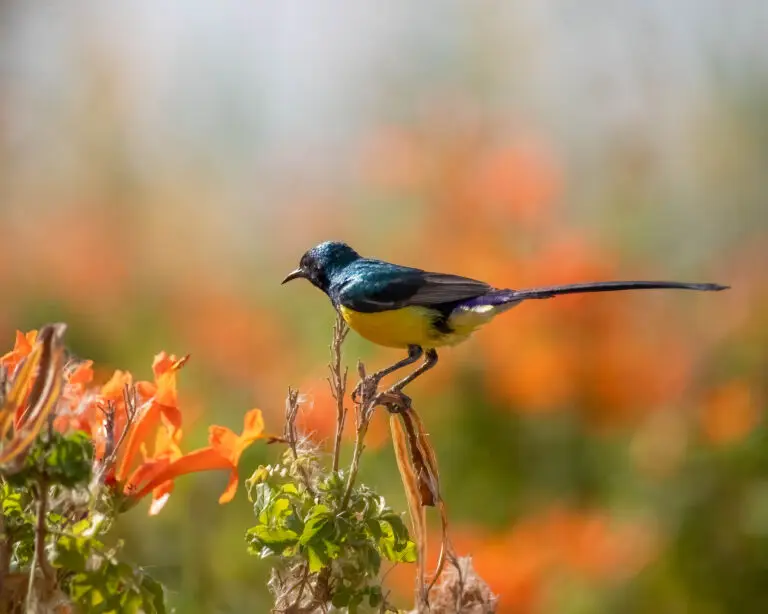
Birds have always fascinated humans with their bright plumage, beautiful songs, and graceful flights. But behind these visible charms lies a hidden world: An astonishing array of senses that allow birds to navigate continents, find food in unlikely places, and survive in challenging environments. These secret senses often surpass human abilities and remind us how finely tuned evolution can be.
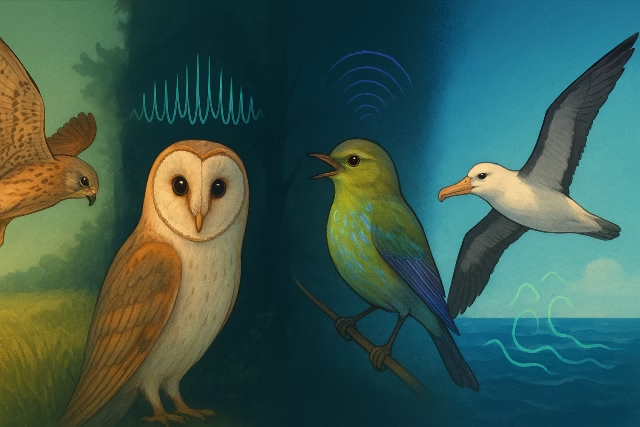
Vision Beyond Our Own
Birds are visual specialists. Their eyes are proportionally larger than ours, giving them remarkable acuity. A kestrel, for example, can spot a mouse moving in a grassy field from over 100 meters away. But what truly sets birds apart is their ability to perceive ultraviolet (UV) light, which is invisible to humans.
This UV sensitivity transforms their world: flowers reveal secret patterns guiding them to nectar, fruits glow more vividly when ripe, and even plumage that looks plain to us shines with hidden colors, helping birds choose mates or recognize rivals. To us, a starling might look dark and glossy, but to another starling, its feathers shimmer with ultraviolet fire.

Touch and Feathers That Feel the Air
Birds don’t simply fly; they read the air. Their feathers are alive with sensation.
Pressure sensors in flight feathers detect tiny changes in airflow, helping swifts and falcons adjust mid-dive with breathtaking precision.
Beaks as tools: Shorebirds like godwits and curlews have nerve-packed bills that feel vibrations deep in the mud, allowing them to find hidden prey without seeing it.
Whisker-like bristles around the beaks of nightjars and flycatchers guide insects into their mouths during fast aerial chases.

A Compass in the Blood
Perhaps the most mysterious sense of all is magnetoreception: the ability to detect the Earth’s magnetic field.
Migration guides: Warblers weighing no more than a few grams navigate thousands of kilometers using the planet itself as a compass.
Theories abound: Some studies suggest birds carry magnetite (a magnetic mineral) in their tissues; others point to specialized light-sensitive proteins in their eyes.
Invisible maps: However it works, this hidden sense allows birds to fly unerringly between continents, across oceans, and back to the same patch of land each year.
To us, migration is a miracle. To birds, it is instinct, written in senses we can barely comprehend.
Smell and Taste: The Overlooked Senses
For years, scientists believed birds had little sense of smell. But research has revealed otherwise.
Seabirds like petrels detect the faint scent of plankton over vast distances, guiding them to rich feeding grounds.
Kiwis use their nostrils at the tips of their bills to forage in soil at night.
Pigeons may even use smell, alongside magnetic cues, to help them navigate home.
Taste is less developed, but some species distinguish sweet from bitter, helping them avoid toxic berries while seeking nectar or fruit.