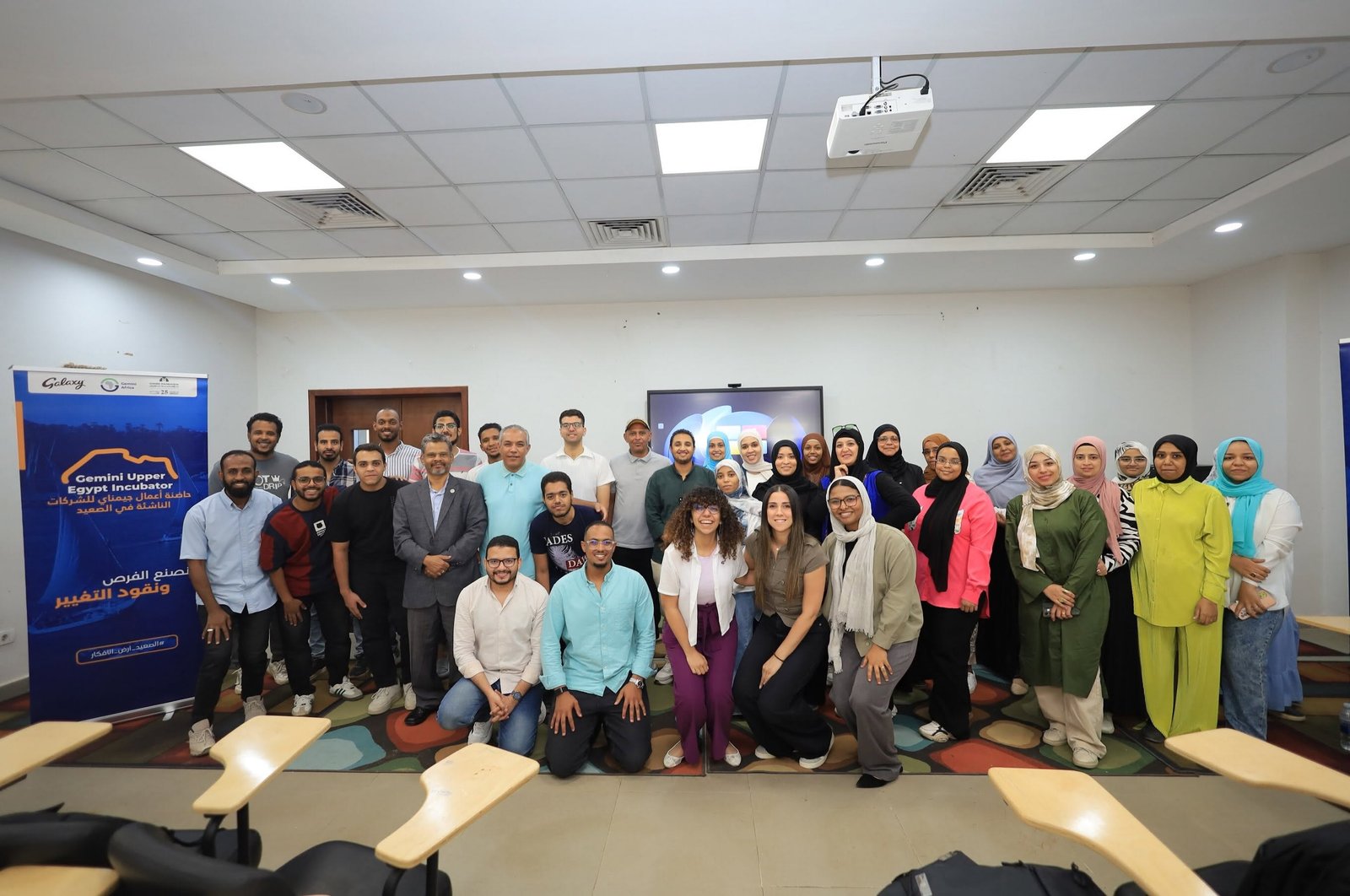
From 28 to 30 June, I participated in the Gemini Upper Egypt Incubator — Round 4, a training programme for startup founders across Upper Egypt, held at Maktabat Misr al-Amma in Aswan. The programme is run by Gemini Africa in partnership with Galaxy and supported by the Sawiris Foundation for Social Development — one of Egypt’s most respected foundations for entrepreneurship and community impact, now in its 25th year of impact.
I walked in as a birdwatching guide. Three days later, I walked out as something more: a founder who understands the architecture of his own business.
Why I Applied with Gemini Upper Egypt Incubator
If you had asked me a few years ago whether I needed business training, I might have said no. I had guests booking trips, positive reviews coming in, and a growing reputation in international birding circles. The business was working — at least in the seasons when it worked.
But I knew, quietly, that something was missing. The summers were empty. The pricing was intuitive rather than strategic. The marketing was reactive rather than planned. I was excellent at finding birds. I was far less excellent at building a business around that skill.
When I heard about the Gemini Upper Egypt Incubator, I saw it as an opportunity to fill exactly those gaps — not just to learn theory, but to sit in a room with other startup founders from Upper Egypt and confront the real questions that most small business owners avoid: Who exactly is my customer? What problem am I solving for them? What is my business model, not as I imagine it, but as it actually operates?
Those are uncomfortable questions. I applied because I was ready to be uncomfortable.
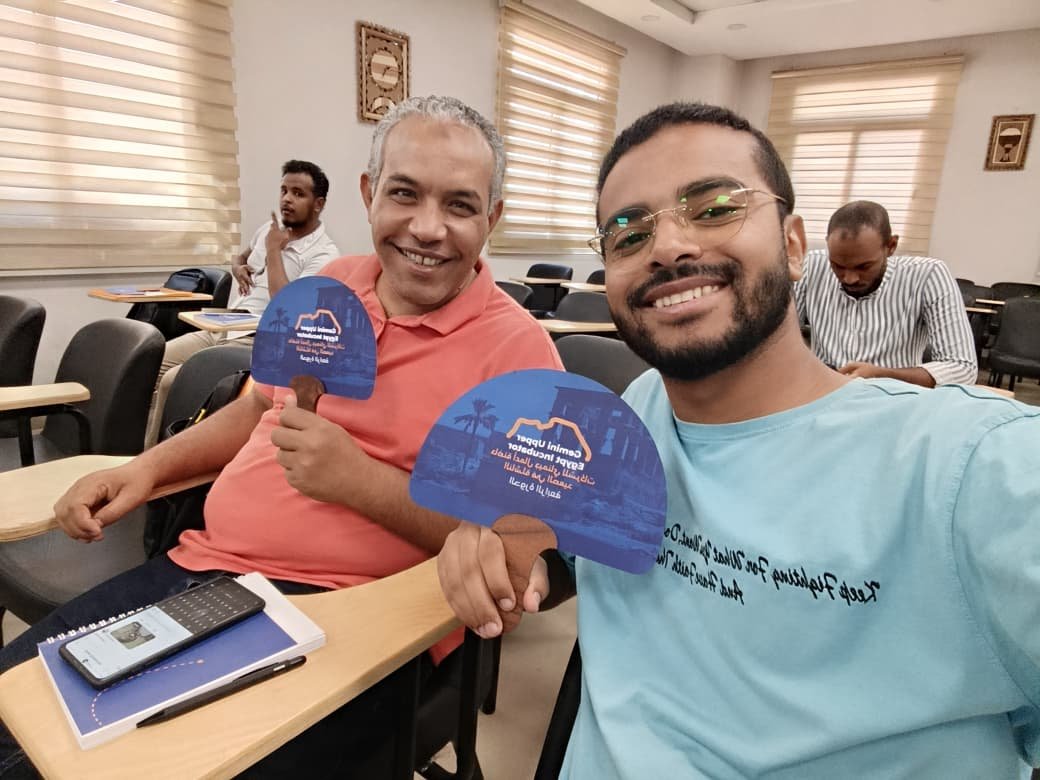
Day 1 — 28 June: Understanding the Market
The first day opened with an introductory session from the Gemini Africa team, setting the tone for what the programme would demand: honesty about where your business is, not where you wish it were.
The afternoon sessions, led by trainer Mohamed El Baheiry, focused on Marketing Research Fundamentals and Customer Segmentation — and they were, for me, genuinely eye-opening.
I had always thought of my customers in broad strokes: birders, nature lovers, tourists. El Baheiry pushed us to go far deeper. Who within those broad categories actually books a trip? What are they searching for when they find you? What do they fear before they arrive? What do they need to feel confident enough to send that first WhatsApp message?
The customer segmentation workshop forced me to map my actual clients in a structured way for the first time. European birders in their 50s chasing Western Palearctic lifers have completely different needs, motivations, and price sensitivities than Egyptian families visiting Aswan on a school holiday, or Gulf tourists looking for an activity beyond the temples. I knew this intuitively — but I had never translated that intuition into distinct marketing strategies for each group.
By the end of Day 1, I had filled more pages of notes than I had in years.
Day 2 — 29 June: Designing the Experience and the Business
If Day 1 was about understanding customers, Day 2 — led by trainer Tariq Fahmi — was about understanding what you actually offer them and why it matters.
The morning session on Design Thinking was one I did not expect to find relevant to a birdwatching business. I was wrong. Design Thinking, as Fahmi presented it, is fundamentally about empathy — about stepping into your customer’s experience and designing your product, your communication, and your service around what they actually feel, not what you assume they feel.
For a guide, this is profound. I had always designed my trips around the birds — the best sites, the most productive times, the species most likely to be encountered. Design Thinking asked me to reframe: what does the guest feel when they step onto the boat for the first time? What do they need in the first five minutes to feel safe, excited, and in the right hands? What moment in the trip do they talk about when they get home?
These are questions of experience design, not ornithology. And they change everything about how you deliver a tour.
The Value Proposition session pushed this further: what is the specific, articulable value that Aswan Birdwatching offers that no one else does? Not “expert guiding” — everyone says that. The real answer, I came to understand, is a combination of access, intimacy, and documentation. We reach islands and reedbeds unreachable by road. We keep the group small enough that every guest gets individual attention. And we provide documented eBird checklists and species notes that extend the value of the trip long after guests have gone home. That combination — access, intimacy, documentation — is the real value proposition.
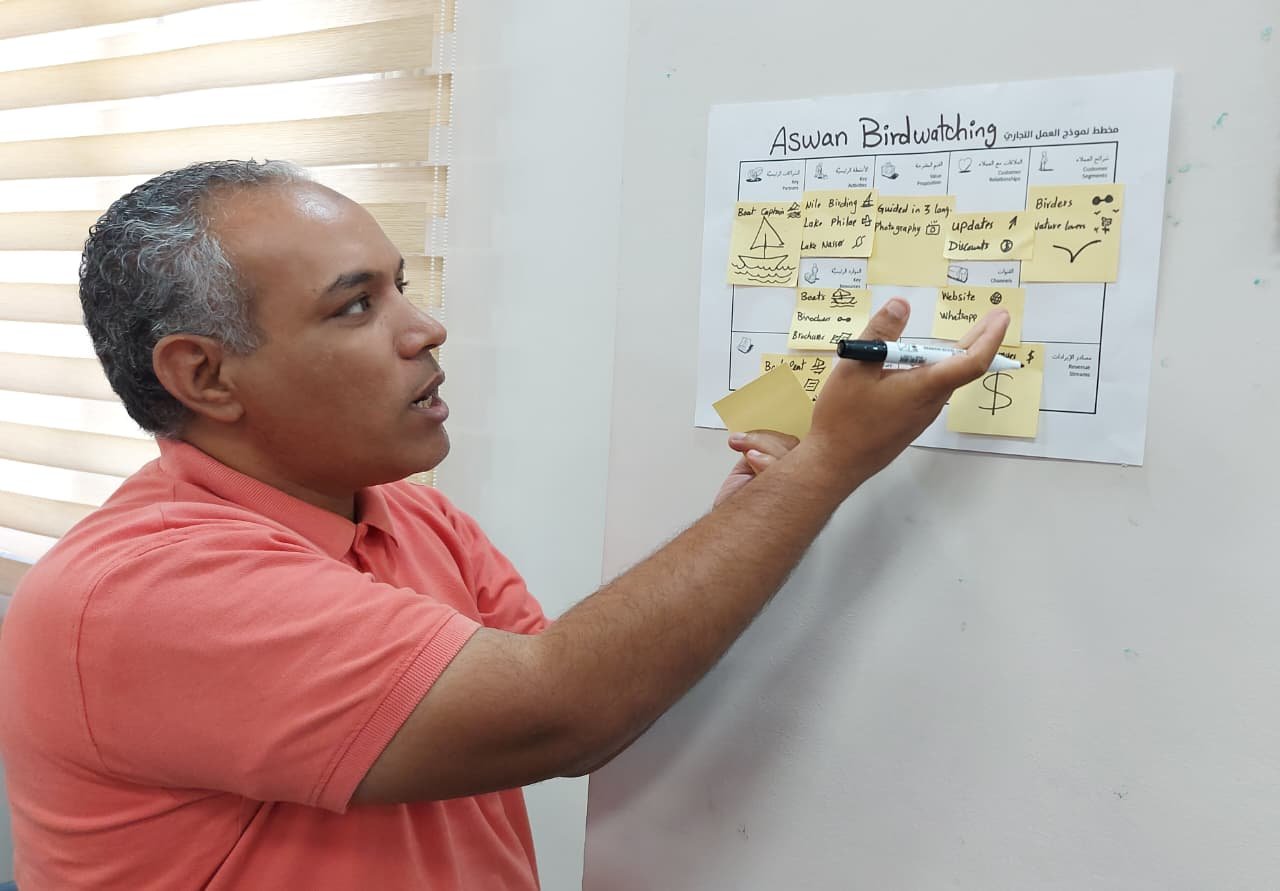
The afternoon session on Business Model Canvas was the most practically useful session of the entire programme. Fahmi walked us through the nine building blocks of any business model — key partners, key activities, value proposition, customer relationships, channels, customer segments, cost structure, and revenue streams — and had us map our own businesses in real time.
Seeing Aswan Birdwatching mapped on a canvas for the first time was a clarifying and slightly humbling experience. Some boxes were full and confident. Others were almost empty — particularly the revenue streams section, which revealed very clearly that I was almost entirely dependent on a single income stream (booking fees) with virtually no passive or recurring income. That is a vulnerability. The canvas made it impossible to ignore.
Day 3 — 30 June: The Numbers Behind the Dream
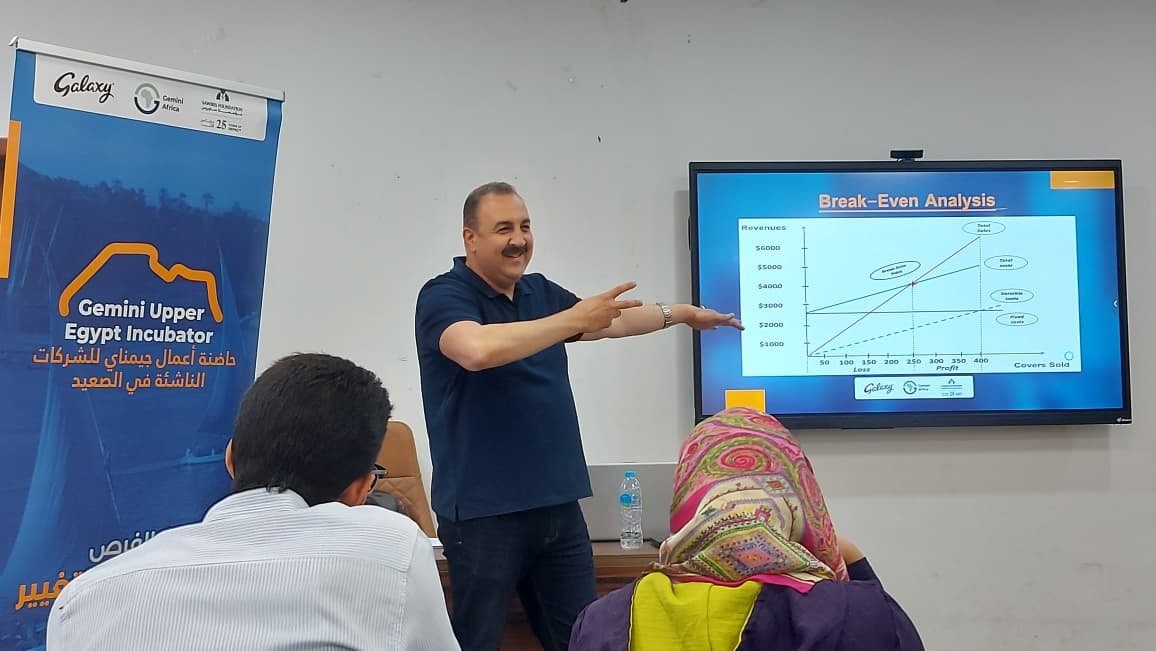
The final day was dedicated entirely to Financial Planning Fundamentals, led by trainer Anas Salem — and it was, I will be honest, the most challenging day of the three.
I am a naturalist by training and a guide by vocation. Financial modelling is not my native language. But Salem was an exceptional communicator — patient, specific, and always grounding the theory in real examples from small businesses in Upper Egypt. By the afternoon, I was working through pricing models, seasonal revenue projections, and cost structures with a clarity I had never had before.
The most important insight from Day 3 was this: the gap between busy seasons and empty seasons is not inevitable — it is a financial planning failure. A well-structured business builds summer into the model from the beginning, prices accordingly, and creates income streams that continue generating revenue even when the main product is seasonally slow. That is not just an operational challenge. It is a financial design challenge. And now I have the tools to address it properly.
What Changes Now
Three days is not enough to transform a business. But it is enough to change how a founder thinks — and that, ultimately, is what changes a business.
I came into the Gemini Incubator knowing how to find birds. I left with a clearer understanding of who my customers really are, what value I am genuinely offering them, what my business model actually looks like when mapped honestly, and what financial levers I need to pull to build something sustainable through all twelve months of the year.
Specific changes I am already working on as a direct result of the programme:
A dedicated summer product. The Lake Nasser Afrotropical Expedition — targeted specifically at Western Palearctic listers who come in summer for Yellow-billed Stork, Village Weaver, Reed Cormorant, and Crimson-rumped Waxbill — needs its own page, its own pricing, and its own marketing campaign. Summer is not the off-season. It is a different season, with a different customer.
A photography tour tier. Wildlife photographers have different needs, different pacing requirements, and different willingness to pay. A dedicated Photography Tour product, priced at a premium and designed specifically around photography opportunities, is a natural extension of what we already offer.
A digital product revenue stream. A downloadable Aswan Birding Guide — covering the best sites, seasonal species calendars, and identification notes — is a passive income product I can create once and sell indefinitely. The Business Model Canvas made very clear that I need income that does not require me to be on the water.
Better customer segmentation in marketing. The WhatsApp messages and Facebook posts I send to European listers should not be the same as what I send to Egyptian families or Gulf tourists. Each segment has different motivations, different questions, and different entry points into the booking process.
A Note on the Programme
The Gemini Upper Egypt Incubator is something genuinely valuable for Upper Egypt’s startup ecosystem. The trainers — Mohamed El Baheiry, Tariq Fahmi, and Anas Salem — brought real expertise and real generosity to the room. The cohort of fellow founders from across Aswan and the surrounding region was a reminder of how much entrepreneurial energy exists in this part of Egypt, and how much it needs the right support to flourish.
For small businesses in the tourism, ecotourism, and creative sectors specifically, programmes like this are not a luxury. They are a necessity. The Nile Valley has extraordinary natural and cultural assets. But assets alone do not build a business. Strategy, clarity, and financial discipline do — and those are learnable skills.
I am grateful to Gemini Africa, the Sawiris Foundation, and Galaxy for creating this opportunity in Aswan. I encourage every serious startup founder in Upper Egypt — regardless of sector — to apply for the next round.