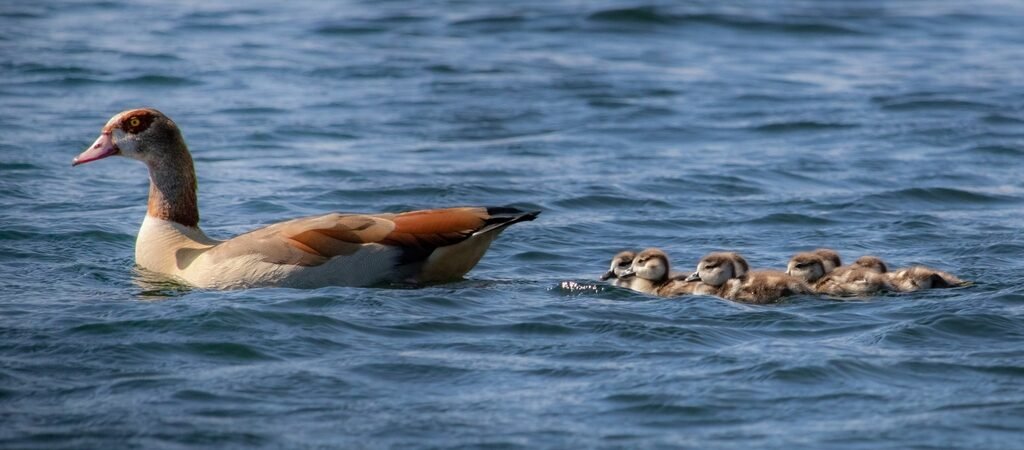
For more than 4,000 years, one bird has watched the Nile flow past temples, villages, and palm-fringed islands. It stood beside kings in ancient paintings, appeared in hieroglyphs, and was admired by the people who built one of the world’s greatest civilizations. Today, that same bird still greets visitors to the Nile in southern Egypt. Let’s explore those 4 interesting facts about the magnificent Egyptian Goose (Alopochen aegyptiaca).

Not Actually a Goose
The first surprise about the Egyptian Goose is right there in its scientific name, if you know how to read it. The Egyptian Goose is not a true goose at all. It is a “sheldgoose,” a goose-like duck in the family Anatidae, placed in its own genus Alopochen.
The genus name itself tells a story. Alopochen comes from the Greek words for fox (alopex) and goose (chen) — early naturalists highlighted the species’ fox-like chestnut tones and patches when framing it in taxonomy. A fox-goose. There is something fitting about that, a bird that does not quite belong to any single category, that sits between the familiar and the unexpected, that has been confusing and delighting observers for centuries.
It is the only living member of its genus Alopochen, meaning that when you watch an Egyptian Goose on the Nile, you are looking at a genuinely singular creature. There is nothing else quite like it anywhere in the world.

Sacred to the Pharaohs
Egyptian geese were regularly represented in ancient Egyptian art, and not merely as decoration. The species held genuine religious significance in one of the world’s most symbolically sophisticated civilisations.
Ancient Egyptian creation stories tell of a first goose, the “Great Honker,” whose cry or egg helped bring the sun into existence. Later writers often linked Nile geese to this myth. The Egyptian Goose was associated with the earth god Geb in temple art, and geese shown along the Nile tied the bird to fertility, the land, and the life-giving floodplain.
To stand on the bank of the Nile at Aswan and watch an Egyptian Goose is therefore to observe something that the ancient Egyptians watched with reverence AS a living thread connecting the modern Nile to a civilisation that built the pyramids. Not many birds carry that weight.
A Warrior in Feathers
Beauty and mythology aside, the Egyptian Goose is also one of the most aggressively territorial birds on the river — and this is where it gets genuinely interesting from a behavioural perspective.
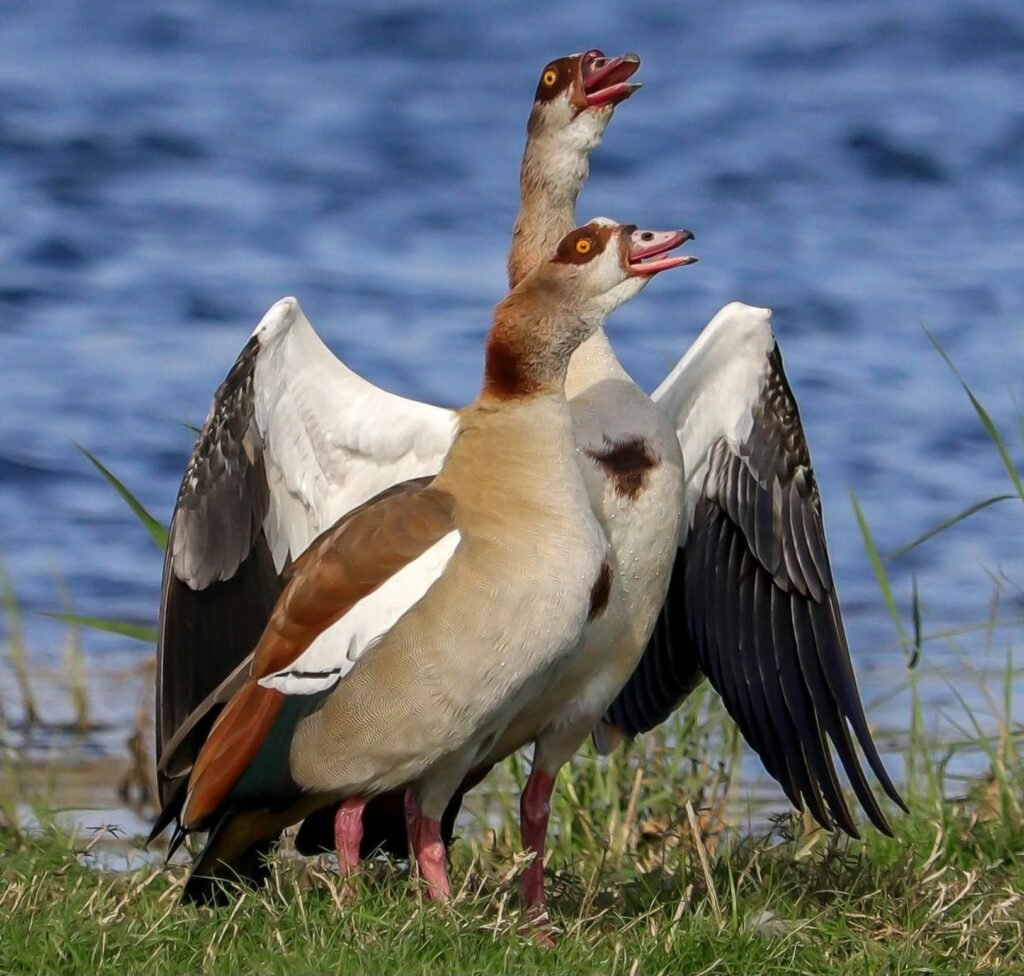
The species is known for its aggressive territorial behaviour, especially during breeding season, and is not hesitant to engage in aerial combat with intruders.
During the breeding season, birds may charge, bite, and strike with wings — and the wing spurs can cause real lacerations or bruising.
The voice matches the personality. The male’s call is a subdued, hoarse sound that becomes louder and more rapid when agitated, resembling a steam engine. The female’s call is raucous and frequently heard, particularly when defending her young. On the Nile at dawn, when a pair has established their territory on a particular island or rock, you will hear them long before you see them — that raspy, accelerating honk rolling across the water in the early morning silence.
The species is monogamous, with both parents caring for their offspring. Family groups — parents with a tight cluster of downy goslings navigating the current — are one of the most endearing sights on the Nile in spring, and a reminder that behind the aggression is a genuinely devoted pair bond.
A Global Traveller
Here is perhaps the most surprising fact about the Egyptian Goose: it has conquered the world.
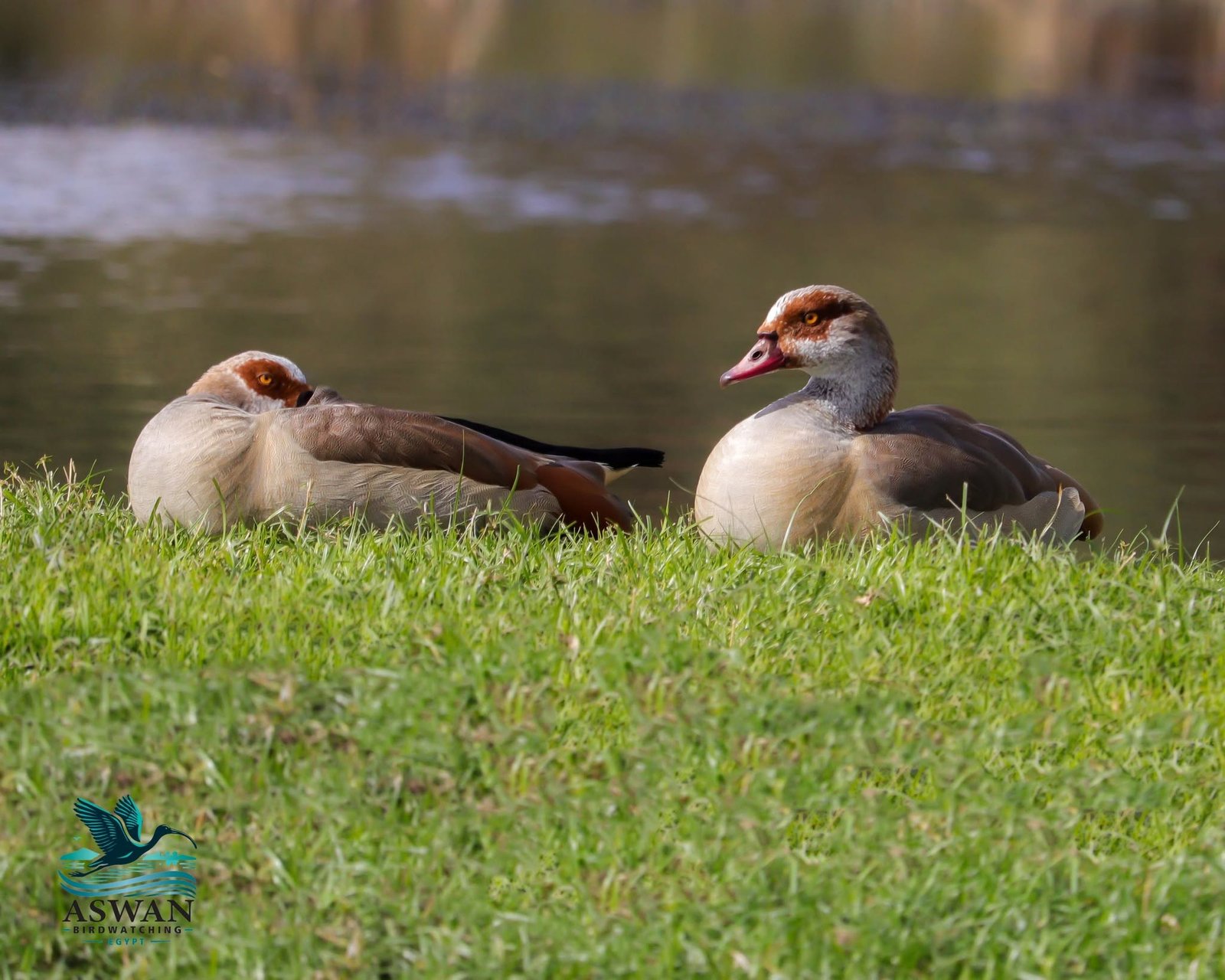
In recent decades, feral populations have become established in parts of Europe, including the United Kingdom, the Netherlands, Germany, and Belgium, as well as in the United Arab Emirates and parts of Texas and Florida in the United States. These populations likely originated from escapees from private collections and waterfowl parks.
Their success in non-native areas is attributed to their generalist diet, bold behaviour, and adaptability to both rural and urban environments. A species that evolved to hold territory on a fast-moving African river against all comers is, it turns out, extremely well equipped to thrive in a European park or an American golf course.
In the Netherlands and UK particularly, the Egyptian Goose has been documented outcompeting other species for nest sites, with studies demonstrating reduced reproductive success for native species due to competition and aggressive behaviour.
The bird that the ancient Egyptians considered sacred is now a management challenge in suburban Amsterdam. There is something both comic and sobering about that trajectory.