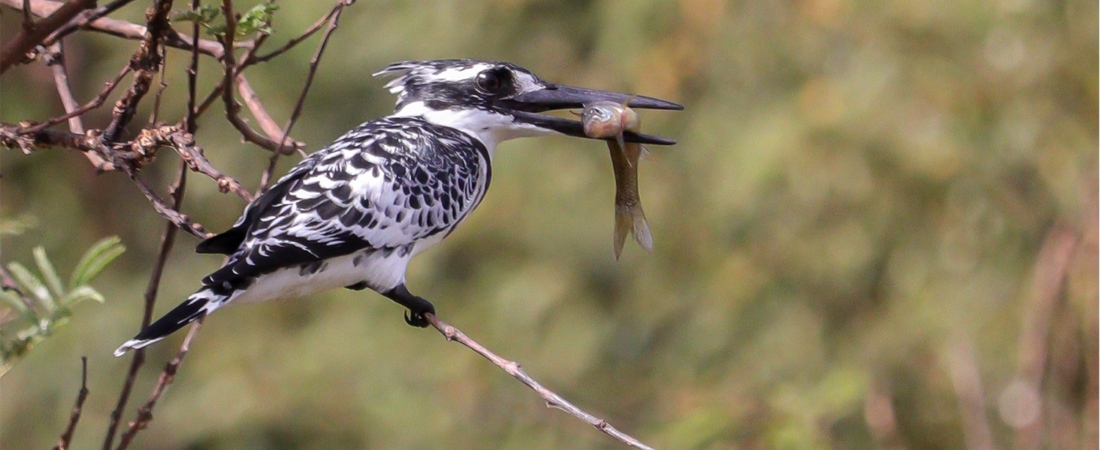
If there’s one bird that steals the show on almost every boat trip we run in Aswan, it’s this one. You’ll hear it before you see it — a sharp, chattering call cutting across the water — and then, if you’re lucky, you’ll catch it doing the thing that makes birders everywhere stop mid-sentence: hanging perfectly still in mid-air, several meters above the Nile, as if gravity has simply agreed to take a break.
Meet the Pied Kingfisher (Ceryle rudis), one of the most captivating birds you’ll encounter on the river — and, in my opinion, one of the most underrated performers in the entire Egyptian birding world.
A bird built like a checkerboard
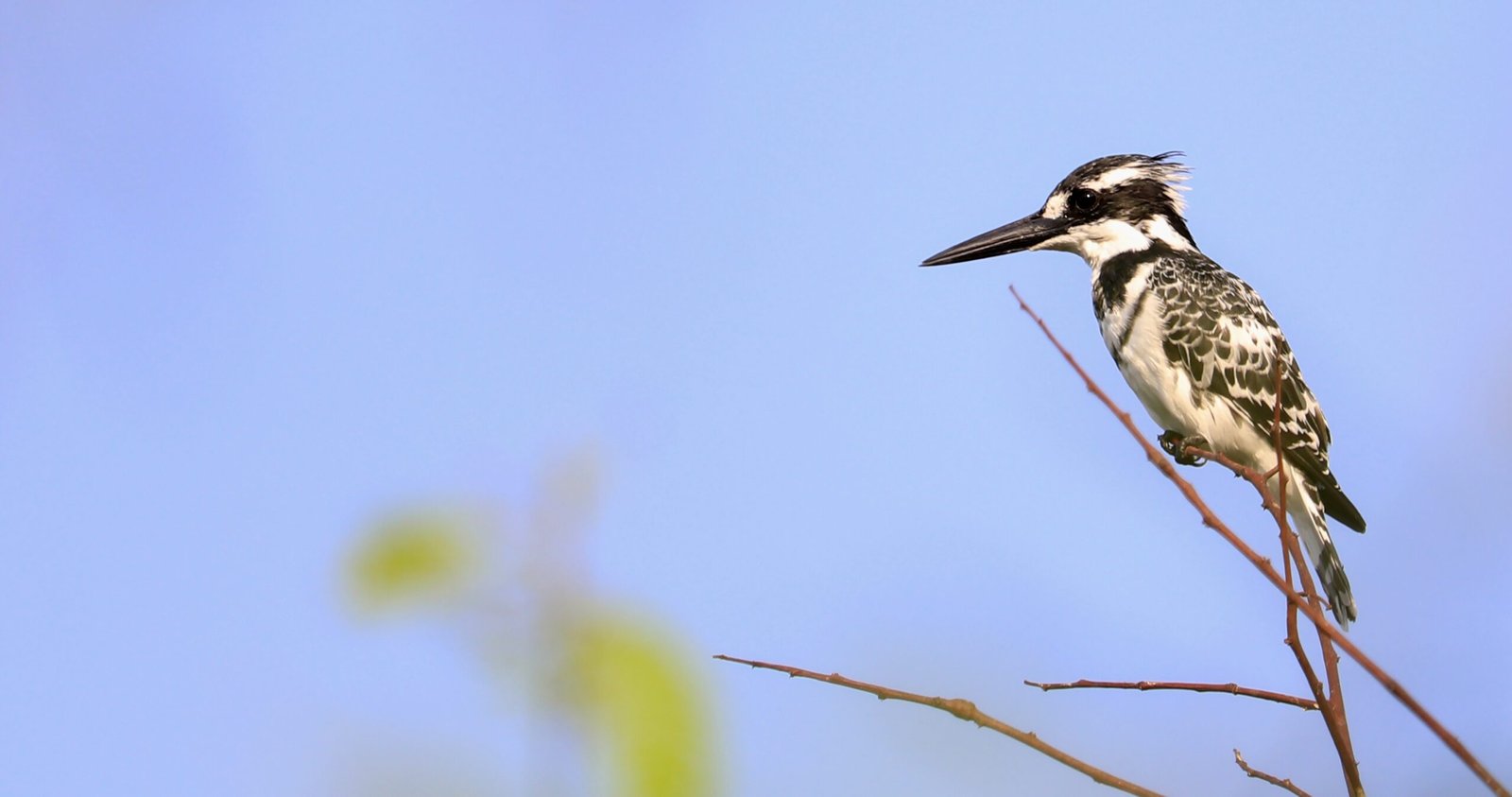
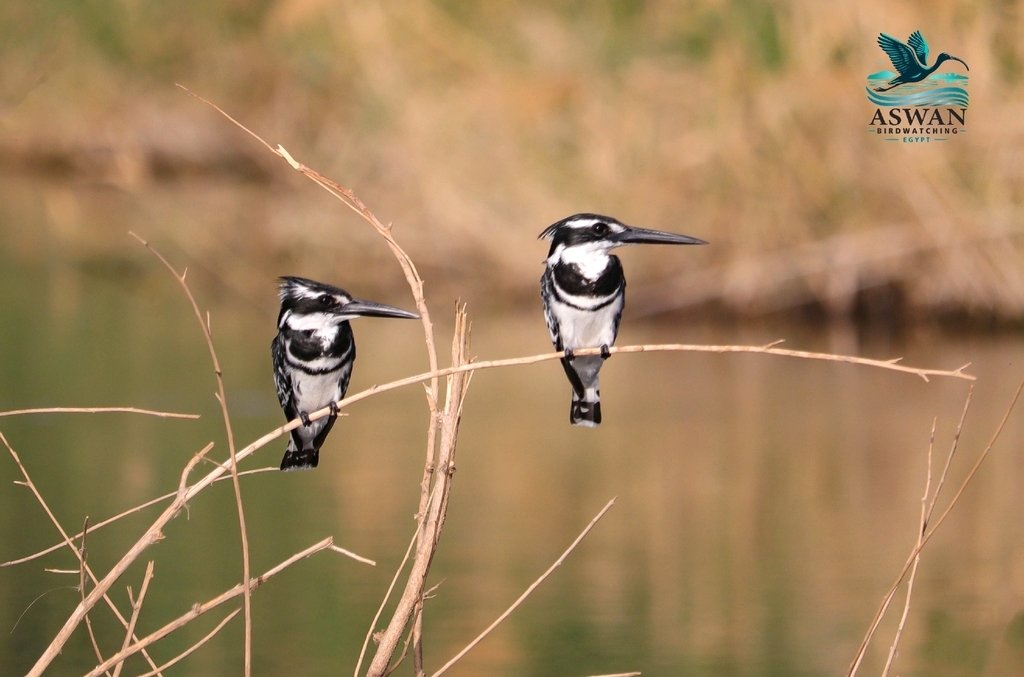
The Pied Kingfisher is unmistakable. It’s the only kingfisher across most of the Old World that comes in pure black and white — no flashy blues or oranges here, just a crisp, contrasting pattern that looks almost hand-painted. A neat crest sits on top of its head, a black mask wraps around the eyes, and the wings and back are barred in intricate black-and-white detail.
There’s an easy way to tell males and females apart in the field: males show a double black band across the breast, while females have just one — and it’s often broken in the middle. Once you know to look for it, you’ll never confuse the sexes again.
At around 25 to 29 centimeters long, it’s a solid, medium-sized bird, and one that seems to know exactly how good it looks perched on a rock at the water’s edge.
The helicopter trick
Here’s the part that never gets old, no matter how many times I see it.
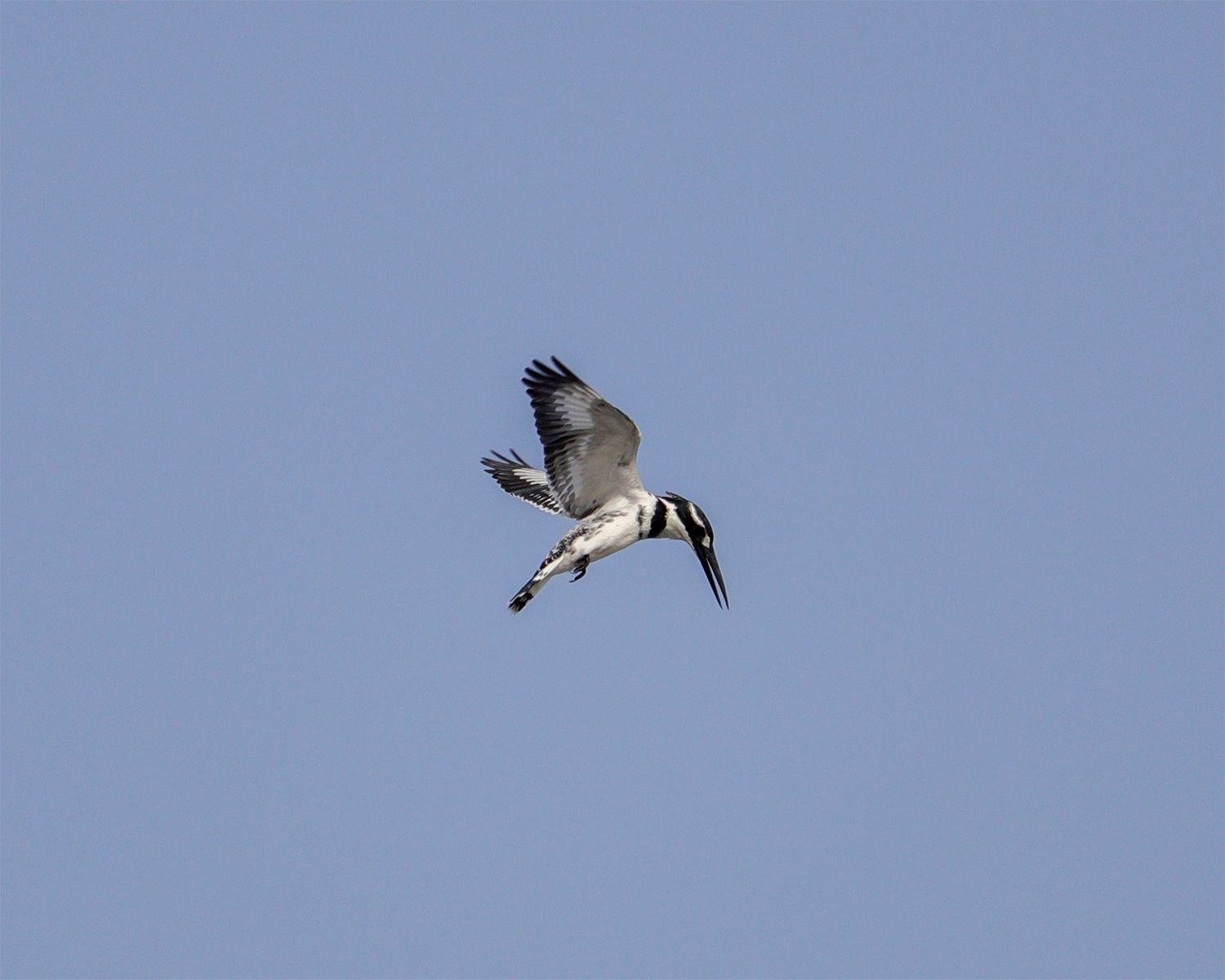
Most kingfishers hunt from a perch — they sit, they wait, they dive. The Pied Kingfisher can do that too, but it has a second trick that most of its relatives simply can’t pull off: it hovers. Properly hovers. It climbs several meters above open water, tips its body almost vertical, beats its wings in a rapid blur, and locks its head completely still while it scans the surface below for fish.
This isn’t a brief hover, either. Researchers studying this exact behavior have recorded hovering episodes lasting anywhere from a few seconds to several minutes, at heights ranging from barely above the water to more than eight meters up. In fact, the Pied Kingfisher is thought to be the largest bird in the world capable of sustained hovering in still air — a genuinely remarkable physical feat for a bird its size.
When it finally commits, it folds its wings and drops headfirst, often vanishing beneath the surface entirely before popping back up, fish in bill, as if nothing happened.
Why bother with all that extra effort when perching is so much easier? Because hovering opens up hunting ground that other kingfishers simply can’t use. A bird tied to riverside perches is limited to the water directly below its favorite branch. A Pied Kingfisher can fish anywhere — the middle of a wide river, open lake water, even areas up to 3 kilometers from the nearest shore. On a wide stretch of the Nile with plenty of open water and not many overhanging branches, that’s a serious competitive advantage.
Interestingly, studies have shown that Pied Kingfishers hover more often on windy days — the moving air actually helps support the hovering flight, making the whole maneuver slightly less energetically costly.
A surprisingly social kingfisher
Most kingfishers are famously solitary and fiercely territorial. Not this one. The Pied Kingfisher bucks the trend almost completely — it’s usually found in pairs or small family groups, and in some areas it forms genuine communal roosts where multiple birds gather together outside the breeding season.
It’s also known to practice cooperative breeding, where “helper” birds — often young from a previous breeding season — assist a mated pair in raising the next brood. That’s a rare and fascinating social structure for any kingfisher, let alone one so widespread.
Watch a family group along the Nile for a while and you’ll notice the constant chatter, the head-bobbing, the tail-flicking — this is a genuinely communicative, socially engaged bird, not the lone hunter you might expect from its cousins.
Nesting in the riverbank itself
When breeding season arrives — typically between February and April here in Egypt — pairs excavate nest tunnels directly into vertical sandbanks along the river. It’s an impressive bit of engineering for a bird with no digging tools beyond its own bill and feet, and it means the steep, exposed banks you might otherwise overlook on a Nile boat trip are often hiding an active nest just below the surface.
What’s actually on the menu
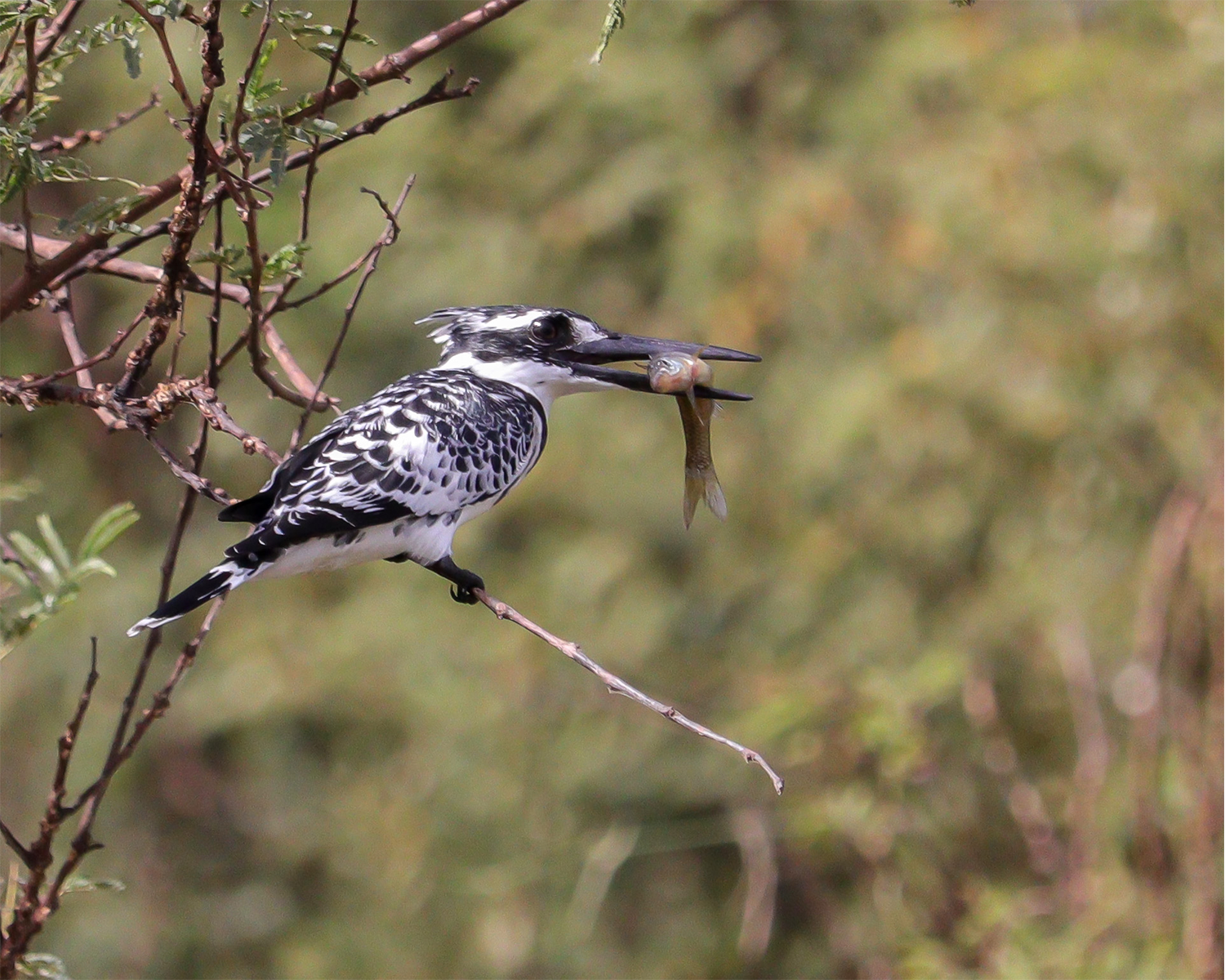
Fish make up the overwhelming majority of the Pied Kingfisher’s diet — typically small fish weighing up to around 26 grams, plunge-caught with remarkable precision. But it’s not exclusively a fish specialist. Aquatic insects like dragonfly larvae, crustaceans, tadpoles, and the occasional small frog round out the menu when the opportunity arises.
One particularly clever trick: this kingfisher can swallow its prey mid-flight, without needing to return to a perch first. For a bird that spends so much time hunting far from any convenient branch, that’s a genuinely useful adaptation.
A small bird with a big reputation
There’s something genuinely thrilling about watching a bird defy the usual rules of its own family. Most kingfishers commit to a perch-and-wait lifestyle. The Pied Kingfisher looked at that arrangement, decided it was far too limiting, and evolved one of the most extraordinary hunting techniques in the entire bird world instead.
It’s a bird that rewards a little patience and a lot of looking up — and on the Nile at Aswan, it’s one of the species I most look forward to sharing with every guest who joins me on the water.
Want to watch the Pied Kingfisher hover and dive for yourself? Join us for a guided birding trip along the Nile in Aswan, where this remarkable hunter is one of the most reliable highlights of the day.